Founders Lodge
The Loneliest Room in the House

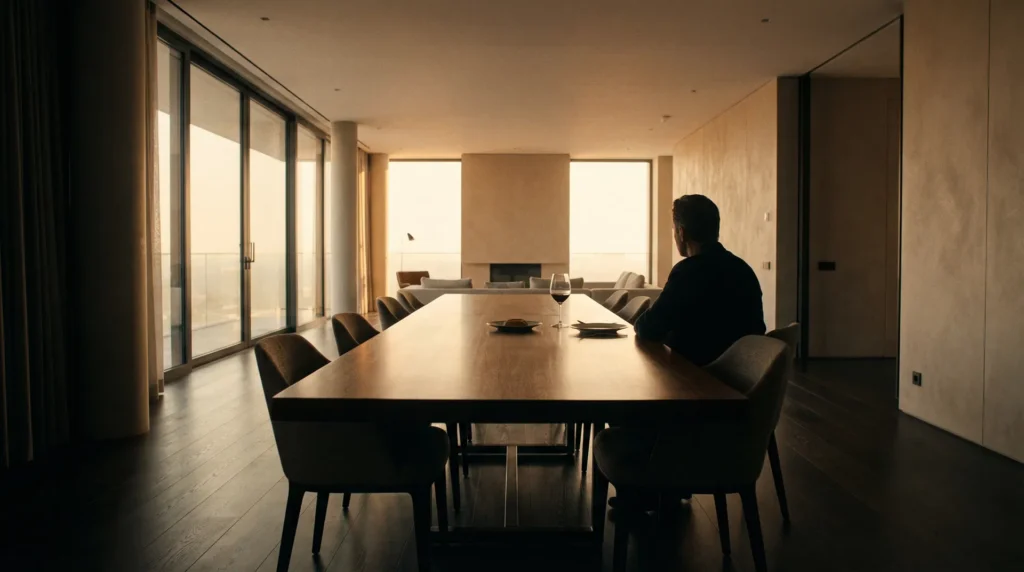
You built the company so your family could have everything. Then you sold it, and realized the company had been getting the best version of you for fifteen years. Your family got what was left over.
The Silence
You're six weeks post-close. The money is in the account. The congratulations have tapered off. Your wife is in the kitchen and you're in the home office, except there's nothing in the home office anymore. No Slack. No board deck to prep.
So you sit there.
She doesn't say anything. She's been not saying anything for about three weeks now. You can feel it. There's a conversation coming and you both know it, and neither of you knows how to start it, because the language you'd need doesn't exist yet. The company gave you a shared enemy for a decade. The cash crunch. The competitor who copied your product. You were a team. Now the enemy is gone. And you're two people in a very nice house who aren't sure what they're a team for anymore.
Where the hours went
A Founder's Week: Before & After Exit
Before Exit
After Exit
Average tech CEO: 4,200 hours/year at work — First Round Review

The Marriage
This isn't a marriage problem. Or it is, but not the way people think. For 10 or 15 years, the relationship ran on a specific set of assumptions. She handled everything at home so you could handle everything at the company. The deal was unspoken but ironclad. And it worked. Until the company was gone and neither of you knew how to renegotiate, because you'd never actually said the original terms out loud.
The invisible contract
The Unspoken Deal: Who Carried What
The roles were never negotiated. They just happened.
Your friends don't help. The ones who haven't exited think you're insane for not being happy. The ones who have exited don't talk about this stuff, at least not in public. So you assume you're the only one.
You're not.
The numbers nobody talks about
You're Not Alone
0%
of entrepreneurs report mental health conditions
Dr. Michael Freeman
0%
of founders report anxiety, depression, or burnout
Fortune, 2025
0
founders joined the Exit Club in 5 months — most showing depression
Sifted, 2023

The Three Versions
There's a version of this story where the founder immediately starts another company. Everybody understands that one. "He's a serial entrepreneur." What they don't say is that sometimes the second company isn't about the market opportunity. It's about having somewhere to go in the morning and someone who needs you to show up.
There's another version where the founder disappears into philanthropy. Joins boards. Starts a foundation. All good things. But sometimes it's less about giving back and more about building a new identity as fast as possible, because the old one evaporated and the silence at home is getting louder.
And there's the version where the founder does nothing. Takes the "gap year." Travels. Reads. Tries to meditate. Tells everyone he's "exploring." And is quietly going out of his mind by month four because he has more freedom than he's ever had and no idea what to do with it. His wife, meanwhile, had plans for this chapter. She'd been waiting years for it. And the person who showed up isn't the person she expected.
What founders actually do
Post-Exit Paths
Most try more than one before settling. None is inherently better.
Sources: Capital Founders, Stanford Search Fund Study, Exit Club

The Conversation
Nobody prepares you for this: the conversation with your spouse three months after the deal, when you have to admit that you don't know who you are without the company, and you're scared, and you don't know how to be home this much, and you're sorry for all the years you weren't.
That conversation changes more than any term sheet ever did. Not the new company. Not the portfolio strategy. Not the trip. A hard, honest talk at the kitchen table that nobody teaches you how to have.
The arc nobody warns you about
The Emotional Timeline After Exit
Year one is disorientation. Year two is experimentation. Year three is when a working hypothesis emerges.
The Lodge
We built the Founders Lodge because this stuff doesn't come up at dinner parties. It barely comes up in therapy. It comes up at 11 PM on a Tuesday with someone who sold their company two years before you did and is willing to tell you what really happened to their marriage in month three.
Those conversations happen over dinner in Burgundy. Pushing a car through the corners at Le Mans. On a river in Alaska at 5 AM when the guide is out of earshot. In Tahiti when the waves are good and the pretense is gone.
Nobody in the room has the answer. That's the point.

Looking forward to meeting you.
Sources. Founder mental health statistics: Dr. Michael Freeman, University of California San Francisco (72% of entrepreneurs affected by mental health conditions). Fortune, 2025 (87% of founders report anxiety, depression, or burnout). Sifted, 2023 (200 founders joined the Exit Club in 5 months). Time allocation data: First Round Review CEO survey. Post-exit path distribution: Capital Founders, Stanford Search Fund Study, Exit Club. Emotional timeline model adapted from Morgan Stanley grief framework and Capital Founders research ("Year one is disorientation, year two is experimentation, year three is when a working hypothesis emerges").